In today’s fast-paced world of digital distractions, a new viral phenomenon has emerged: the high-stakes visual perception challenge. As a long-time observer of how our brains interpret—and misinterpret—the world around us, I’ve witnessed how a simple grid of numbers can turn a peaceful afternoon into a competitive frenzy.
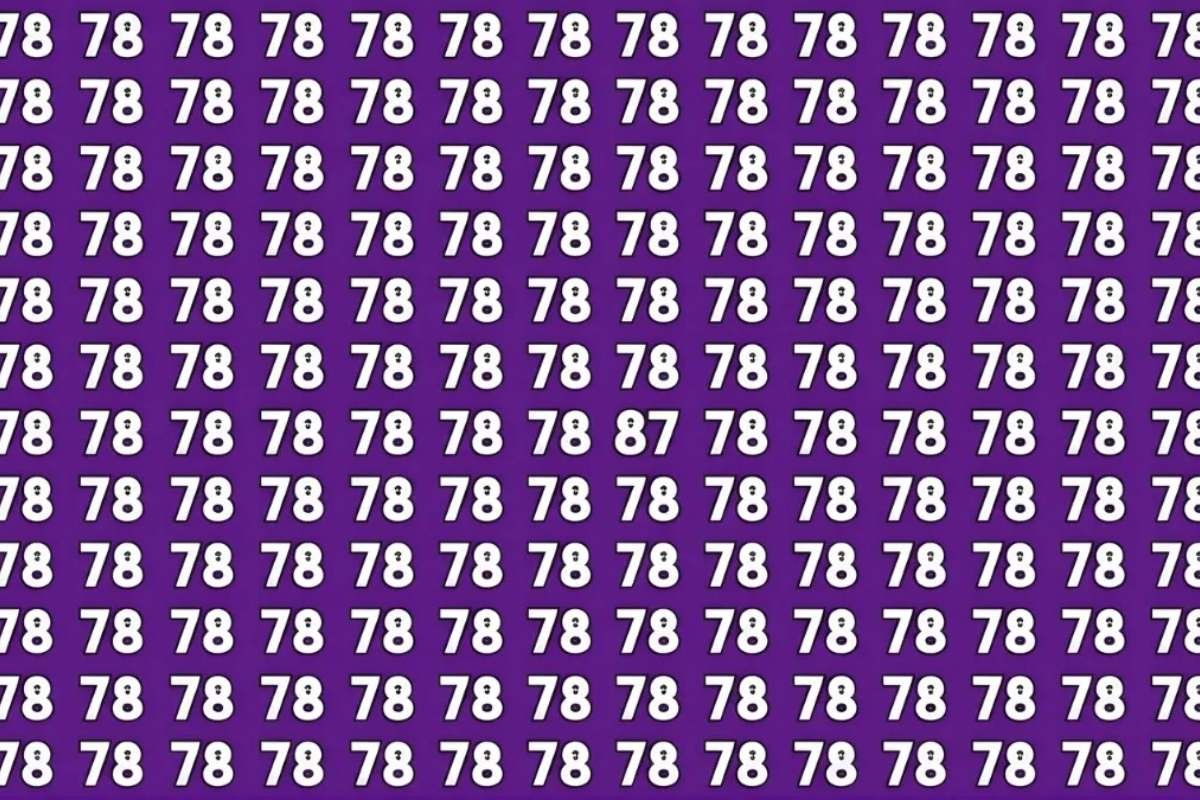
Today, we will look at a classic numerical optical illusion. A single 87 is hidden within a dense, repetitive “sea” of the number 78. It sounds simple, doesn’t it? However, there is a catch: to join the elite tier of “super-sighters,” you must locate it in 7 seconds or less.

Before we get into the grid, let’s look at why your brain might struggle with this particular optical illusion brain teaser and why these puzzles have captured the global imagination through the lens of modern neuroscience.
Optical Illusion: Find 87 among 78’s in 7 Seconds
What are Optical Illusions?
An optical illusion (also known as a visual illusion) is essentially a disconnection between reality and perception. It happens when the information gathered by the eye is processed by the brain in a way that does not correspond to the physical measurement of the stimulus.
According to a review in Nature Neuroscience, researchers discovered “illusory contour-encoder” neurons in the primary visual cortex (V1) that respond to these visual “tricks” even when the physical stimulus is not present. In the case of our “78 vs 87” puzzle, we’re working with a literal optical illusion.

This is not about moving shapes, but about pattern recognition interference. Because the digits 7 and 8 are the same in both numbers but reversed, your brain attempts to “bulk process” the data to save energy, often smoothing over the anomaly as if it were just another 78.
What Makes Optical Illusions Popular?
Why do we spend hours squinting at optical illusion pictures? The popularity of these puzzles stems from several psychological and evolutionary drivers:
- Evolutionary Efficiency: Research from the American Museum of Natural History suggests our brains evolved to work quickly, piecing together fragments of information to survive. We are naturally drawn to things that challenge this “fast-thinking” system.
- The Instant Feedback Loop: Unlike complex tasks, a visual puzzle provides immediate gratification.
- Social Competition: Beating a 7-second timer suggests superior cognitive focus, making these challenges highly shareable on social media.
- The “Aha!” Moment: There is a genuine neurochemical reward—a hit of dopamine—when your brain finally breaks the pattern and “finds” the hidden object.
How Optical Illusions Work?
The science underlying optical illusions involves a complex dance between the eyes and the brain. Our brains are hardwired to seek structure and logic, also known as Gestalt principles.

When you look at a sea of 78s, your brain applies the Law of Similarity to group the identical numbers into a consistent “texture.” To find the 87, you must intentionally break the grouping. Furthermore, our eyes make “saccades”—quick, tiny jumps. According to a study published in 20/20 Magazine, the superior colliculus moves the eyes in these jumps, and if your eye “skips” the 87 during a saccade, your brain’s “auto-fill” feature assumes it was another 78. This is how the number can be “hidden” in plain sight.
Benefits of Practising Optical Illusion Puzzles
Engaging with mind-bending optical illusions isn’t just a way to kill time; it’s a workout for your cognitive health. Peer-reviewed insights suggest several benefits of practicing optical illusion puzzles:
- Improved Cognitive Flexibility: You train your brain to switch between global processing (seeing the whole grid) and local processing (focusing on individual digits).
- Enhanced Visual Literacy: Regular engagement with eye-testing illusions improves your ability to derive meaning from complex visual information—a skill vital for data analysis and professional focus.
- Neuroplasticity: Researchers suggest that challenging the brain with “ambiguous” or “hidden” images forces the brain to “flip” its interpretation, keeping neural pathways active and engaged.
- Stress Reduction: Much like a meditative “flow state,” focusing intensely on a hidden object puzzle can provide a mental break from daily stressors.
Optical Illusion Solution: Did You Find It?
If the 7-second timer ran out and you were still squinting at the screen, don’t be discouraged. The numerical optical illusion is based on “crowding,” in which objects in the periphery blend into a single texture.
Now let us reveal the solution!
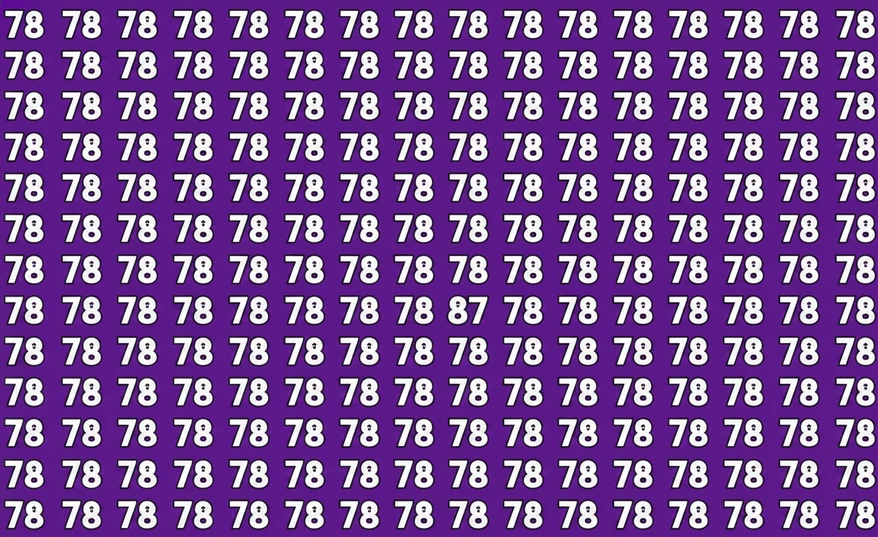
If you divide the grid into quadrants, pay attention to the lower-middle section. The elusive 87 is located in the eighth row down, roughly the ninth column from the left.
Once you see it, the “illusion” fades and the number appears to pop out of the background. This is referred to as perceptual learning—your brain has now “mapped” the anomaly, which you will most likely find immediately if you look at the grid again tomorrow.
What started out as a simple search for a hidden number has turned into a masterclass in how our biology influences our perception. As previously discussed, the difficulty of spotting a single 87 in a sea of 78s is not a sign of poor eyesight; rather, it demonstrates the efficiency of the human brain.
Your mind is an expert at “filling in the blanks,” a skill that helped our ancestors spot predators in tall grass but makes locating a transposed digit a frustrating visual perception challenge.
Regularly engaging with an optical illusion brain teaser is essentially “gymnastics training” for your neurons. You’re teaching your brain to question its first impressions and look beyond the patterns it desperately wants to form. In an age when deep focus is in short supply, these mind-bending optical illusions act as a playful yet effective tool for reclaiming our attention spans.